
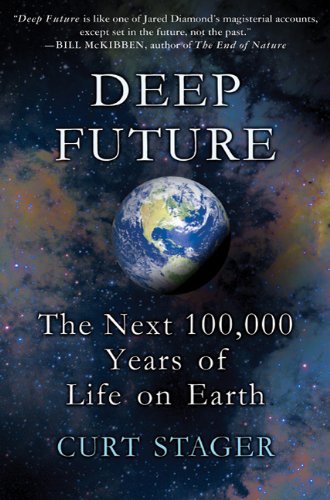
Last week, I finished reading Curt Stager's amazing book Deep Future: The Next 100,000 Years of Life on Earth. It was a book that is certainly worth reading, but at first glance one might ask what good is a book like this, one that purports to look far into the future beyond not only our own lifetimes but those even of our grandchildren and great-grandchildren (and many generations beyond that too). Of course, none of us will be here to witness whether Stager's predictions are true, but we can be assured that they are not blind prognostications. Stager is a paleoclimatologist by trade, meaning he looks to the record of rocks, ice and lake-bottom deposits to determine what past climates were like, using this information to help us understand what might be coming based on our actions in the present. This book is one of evidence-based reasoning presenting a range of possibilities for our future on this planet, based on whether we take a moderate-emissions path or a high-emissions path. The future will look quite different if we choose to burn through our fossil fuel reserves in the 5,000 Gigaton emissions scenario rather than the moderate 1,000 Gigaton emissions path (which will still have consequences).
Taking the long view of the climate crisis is instructive in several ways. We are reminded that, beyond any reasonable doubt, humans are responsible for the current and ongoing changes in climate. Our fossil fuel resources are finite, a one-shot gift from earth's long past. We should be cautious in using them all up within a period of several hundred years, because we will not get this chance again, and future generations of humans may need them for something far more important than the running of cars. The changes in climate are long-term; by reminding us of this Stager is certainly not an "alarmist". The changes will happen slowly, but at the same time the long perspective reminds us that these changes are still far more rapid than anything the earth has previously witnessed. The Greenland ice sheet may take a thousand years to fully melt (though there is some uncertainty that may point towards the possibility of a rapid disintegration), but melt it will, raising the levels of the seas and changing the world as we know it.
The changes in climate that we are likely to witness will not be the end of the world, and humans as a species will be here to witness it. However, because of our actions many other species will not be. Stager spends some time on the ocean acidification that is resulting as a consequence of our actions, a very troubling prospect indeed, and on the divergent paths that it may take. The long view of the climate is somewhat reassuring, as life will survive and the full effect of our changes will take thousands of years to come fully into effect. However, the long view also reminds us that the actions we take now will shape the climate far into the future. Our current emissions will take over a hundred thousand years to cycle back out of the atmosphere (for the moderate emissions scenario; for the high emissions scenario around half a million years will pass before carbon levels in the atmosphere return to what they were before the burning of fossil fuels). Given the length of time involved, we have a grave responsibility to act to mitigate our emissions, for the future good of life on earth. All in all, Stager reminds us that we shouldn't panic, that there is time to mend our ways, but that we are still obliged to take action to mitigate our impact whatever that action will turn out to be.
Read this book, that's all the more I can say. It is a book on science that is written to be accessible to the educated reader.

Taking the long view of the climate crisis is instructive in several ways. We are reminded that, beyond any reasonable doubt, humans are responsible for the current and ongoing changes in climate. Our fossil fuel resources are finite, a one-shot gift from earth's long past. We should be cautious in using them all up within a period of several hundred years, because we will not get this chance again, and future generations of humans may need them for something far more important than the running of cars. The changes in climate are long-term; by reminding us of this Stager is certainly not an "alarmist". The changes will happen slowly, but at the same time the long perspective reminds us that these changes are still far more rapid than anything the earth has previously witnessed. The Greenland ice sheet may take a thousand years to fully melt (though there is some uncertainty that may point towards the possibility of a rapid disintegration), but melt it will, raising the levels of the seas and changing the world as we know it.
The changes in climate that we are likely to witness will not be the end of the world, and humans as a species will be here to witness it. However, because of our actions many other species will not be. Stager spends some time on the ocean acidification that is resulting as a consequence of our actions, a very troubling prospect indeed, and on the divergent paths that it may take. The long view of the climate is somewhat reassuring, as life will survive and the full effect of our changes will take thousands of years to come fully into effect. However, the long view also reminds us that the actions we take now will shape the climate far into the future. Our current emissions will take over a hundred thousand years to cycle back out of the atmosphere (for the moderate emissions scenario; for the high emissions scenario around half a million years will pass before carbon levels in the atmosphere return to what they were before the burning of fossil fuels). Given the length of time involved, we have a grave responsibility to act to mitigate our emissions, for the future good of life on earth. All in all, Stager reminds us that we shouldn't panic, that there is time to mend our ways, but that we are still obliged to take action to mitigate our impact whatever that action will turn out to be.
Read this book, that's all the more I can say. It is a book on science that is written to be accessible to the educated reader.
Comments
Post a Comment