
The list of books I need to read, as always, grows only longer, but this is not a bad thing. This morning, Carl Zimmer noted in his blog the oddities of the Cambrian, some of the strangest forms preserved in a fossil record that already contains some very strange organisms, from feathered dinosaurs to brontotheres and the ancestors of humans. These organisms, many of them preserved in the Burgess Shale (famously covered in the work Wonderful Life by the late Steven Jay Gould), represent creatures so fantastical that scientists have trouble connecting them to existing forms of life. Zimmer linked to that book, along with a relatively new book called The Cambrian Explosion: The Construction of Animal Biodiversity, available here from the publisher but also from other booksellers. Of course, given my enthusiasm for weird dead animals, I immediately added it to my to-read list, but the significant cost of the work, and the fact that I've recently indulged myself with a new dinosaur book (A really cool one on sauropod dinosaurs! Look at it here.) means that I won't be adding this one in the near future.
Regardless, seeing that article is a reminder that the wonders of the fossil record aren't confined just to the majesty and grandeur of the reign of the dinosaurs. Looking at the fossil record unveils all manner of organisms, a pageant of life produced by the workings of evolution and unmatched by the imagination of human beings. Just one creature out of the multitude of Cambrian oddities serves to illustrate the point. The image below is of an Opabinia:
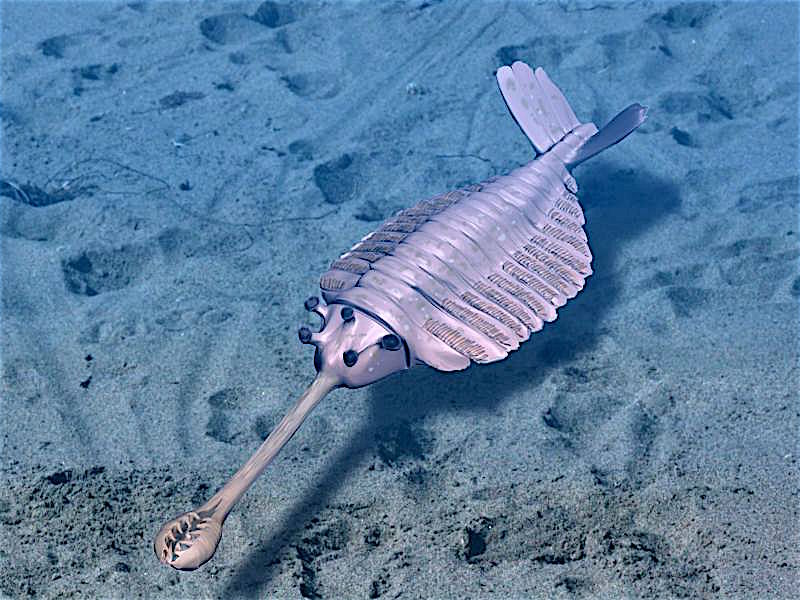
This image is not taken from the aforementioned The Cambrian Explosion due to considerations of copyright (it is used under Creative Commons with no commercial intent), but the images from the book that Zimmer displays in his own blog are spectacular and worth a few minutes.
Paleontology is a science very much open to interpretation due to the nature of the geologic column and the fossil record preserved within. Yet at the same time, some general statements about the Cambrian can be made, assertions that undermine common creationist claims about the significance of the Cambrian Explosion. The harpies of ignorance seize upon the word "explosion" and take it to mean that these forms sprang into existence quite suddenly, ergo creationism is right. But that isn't nearly the case, and the use of the term "explosion" is misleading here. What is an instant in geologic time still plays out over what are great spans of time when compared to our finite human existence. Estimates of just how long the Cambrian Explosion took range from five million years to forty, though a range of five to ten million years seems most likely. Even the most conservative estimates of how long it took still represent enough time for the great diversification of life that the Cambrian shales represent--after all, it took far less than ten million years for evolution to transform our most ape-like ancestors into all of us, walking about the earth with books and iPods. Further, fossils found after the discovery of the Burgess Shale, and Gould's work on the topic, seem to indicate that the fossils preserved represent better preservation of fossils as organisms developed hard, calcium-rich body parts.
Regardless of just how and why the Cambrian Explosion happened (and the ideas are diverse and fascinating, including the "snowball earth" hypothesis) it is important to occasionally step back from these questions and just marvel at it all. Sometimes, it is enough simply to look at what was and stand in awe of the creatures that once occupied our planet.
Comments
Post a Comment