
A few days ago, a friend of mine posted a blog listing the twelve books he recommends for understanding the world. These are, in his words, essential reads. This post made me start thinking of what my own list would be. A list like this is going to be different for each reader, for we are all individuals and different books will impact us in different ways, based on our own tastes and where we are in life when we encounter a work. So what books would I recommend for understanding the world? I read so much, that narrowing it down was a tough call; this list will, I'm sure, certainly change as time goes by. At this point, however, these twelve books are ones that have helped me understand the world a little better in one way or another, books that moved me or enraged me, ones that have helped to transform how I see and think about the world.
1. The Children of Hurin by J.R. R. Tolkien
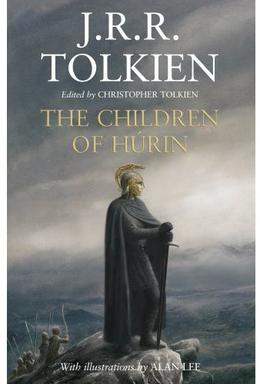
Some of my friends might be surprised that I didn't choose The Hobbit for this list, as that particular book is an undeniable favorite of mine. But while I love the story, and think that many of the themes are important, The Children of Hurin affects me more deeply in some ways. While The Hobbit touches on themes of courage and the perils of greed, among others, Children is a tale far more grandiose, the tragic story of Turin, the son of Hurin. Tolkien's work, brought together by his son and literary heir Christopher Tolkien, touches on notions of fate and the folly of pride, set in a period of Middle Earth far more ancient and perilous than even the time of Lord of the Rings. It is a beautiful, masterfully done work. Just read it.
2. Here on Earth by Tim Flannery
The first non-fiction work on my list is one of the most interesting and inspiring works I've read in the last several years. An ultimately hopeful synthesis of environmental thought, earth history, evolutionary biology, and many other topics, Flannery looks holistically at the Earth both past and present to give a sense of where we've been, where we are and where we may be going. I remember being impressed by the sheer scope of the work, and looking back over the table of contents I'm impressed anew at the disparate topics Flannery assembled, from a discussion of the selfish gene idea to asking why we love our lawns so much. The work is worth reading just for the last portion of the book, in which Flannery presents some thoughts on where we are going both as part of Earth's biosphere and as a species.
3. Merchants of Doubt by Naomi Oreskes and Erik M. Conway
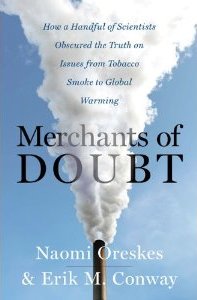
I've written elsewhere about this book, and it has truly changed how I view the world. Starting with the campaign to discredit the science behind the tobacco-cancer link, the two authors expertly trace the threads of the denial campaign by certain scientists from tobacco and acid rain to climate change. Make no mistake, these industry-funded scientists have done and continue to do terrible damage to this country in using their credentials to manufacture doubt about what is often settled science. The scientists themselves may lie, but the documents Oreskes and Conway unearth do not. How long, I wonder, will they continue to help delay action, and what will that cost us as a species in the end?
4. The World Without Us by Alan Weisman
Continuing the environmental theme, Weisman's work frames the environmental question in a novel and interesting way--what would the planet look like without us? Taking as his starting point the total and overnight disappearance of every human on the planet, he examines a variety of places on our planet to measure our impact. It is a curious and often disturbing journey.
5. Why Evolution is True by Jerry Coyne

Certainly the best summation of the evidence for evolution I've read, Why Evolution is True presents a readable overview of the overwhelming evidence in support of the theory of evolution. Ranging from fossils to bacteria and beyond, I find it hard to believe that anyone but the most hardened young-earth creationist could read this book and come away unmoved. Coyne's work is useful for anyone who knows that evolution is true but may not quite know some of the support that various branches of science have uncovered. Even more than a weapon in the endless evolution-creation debates, this book helps to understand the theory, and to convey some of the majesty inherent in this view of life.
6. The Martian Chronicles by Ray Bradbury
I've read a number of works by Bradbury, and they were all fantastic reads, from his famous Fahrenheit 451 to collections of short stories like The October Country. For me, The Martian Chronicles is special. It was the first Bradbury work I read, all the way back in junior high school, and it has stayed with me in all the years since. To read Ray Bradbury is to read the works of a man who understood humanity in all its strengths and flaws, and this book is in my mind the best representative of this. A collection of short stories charting a future human presence on Mars from the first landing to the final abandonment of the colony when humanity destroys itself back on Earth, Bradbury knows us intimately, from our fear of outsiders to our desire to be loved, even at the ending of the world. Even if you think you won't like it, you owe Bradbury at least a try.
7. The Demon Haunted World by Carl Sagan
A spirited defense of science in a world full of superstition, one of Sagan's last works is worth the read. Science represents, Sagan says, a small light in the darkness, and proceeds with a vigorous defense of science, debunking various forms of superstition and unreason from UFOs to faith healing in the process.
8. The Wrecking Crew: How Conservatives Rule by Thomas Frank
This work, from the author of What's the Matter with Kansas, details the systematic efforts of the conservative movement to undermine and dismantle the workings of government from the early days of the Goldwater movement to the radical lunacy of the Bush years. As a student of history, I believe that to understand where we are, we have to know where we've come from, and this book is essential to understand how we got to where we currently stand in Washington.
9. Misquoting Jesus by Bart D. Ehrman

I haven't read a book by Ehrman that I haven't enjoyed, so far. His works are very readable distillations of some current ideas in biblical scholarship, and Misquoting Jesus is no different. Presenting to the general reader a discussion of "textual criticism," the scholarly reading of the text, Ehrman guides us through how many parts of the New Testament were changed and why, and more importantly why scholars believe this to be the case. Growing up in a fundamentalist church, Ehrman's work was an important step in coming to a different, more nuanced understanding of the Bible, and this work is toxic to that same fundamentalism that characterized my religious experience in youth.
10. Sex at Dawn by Christopher Ryan and Cacilda Jetha
Recommended to me by a friend, this book changed how I think about human sexuality. Making a persuasive case for a different understanding of our sexuality, the two authors draw on a remarkably diverse range of information in support of their controversial thesis, namely that monogamy is not the natural state of humanity. Whether you agree with their assessment or not, their work is certainly an interesting one.
11. Night Falls Fast: Understanding Suicide by Kay Redfield Jamison
This is probably the most disturbing work on my list, yet the topics that it discusses are important. Jamison, a psychologist at Johns Hopkins, deftly weaves a work that brings together science, case studies, and her own personal history to answer the question of why people choose to commit suicide. This is a major public health crisis, she writes, one that we ignore because it makes us profoundly uncomfortable. Yet we owe it to ourselves and those around us to try and better understand this distressing fact, that suicide ranks high on the list of causes of death, especially for young people. Jamison brings to this topic not only a deep understanding of it but also the skills of a great writer, as she does with all of her works.
12. Stargirl by Jerry Spinelli
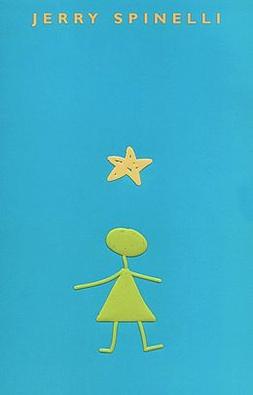
This is probably the most surprising book on the list, but allow me to make my case. Not many works of fiction ended up on the list, and this in many ways reflects my own preferences as a reader. But Stargirl is something remarkable, a beautiful story of a boy trying to find his way through the minefield of high school and a girl who dared to be profoundly and remarkably different in a culture that rewards conformity. It is a work about the courage it takes to truly be ourselves, how hard it can be to go in the face of peer pressure even when we know that it is right. While many of the books on my list are about understanding the world, Stargirl asks us to understand ourselves.
Just one more--
It's taken me a while to reach the end, but I would take a moment to throw in one last book to make an even thirteen. Last summer I read Bertrand Russell's The Conquest of Happiness, and it impacted me in a very real and meaningful way, in ways I haven't fully come to understand. Russell's premise is a simple one; in many cases we already have within us the power of being happy, if only we can realize it. Happiness is not, he posits, something that just happens to us, it is something we must work towards, something we earn rather than are given. The central message is powerful and profound, and stays away from any sort of wishful thinking or "if you dream it you can do it" mysticism. No, this is a hard-nosed, realistic assessment of the things that make us unhappy and how the right perspective can do a lot to bring happiness to us.
Comments
Post a Comment