
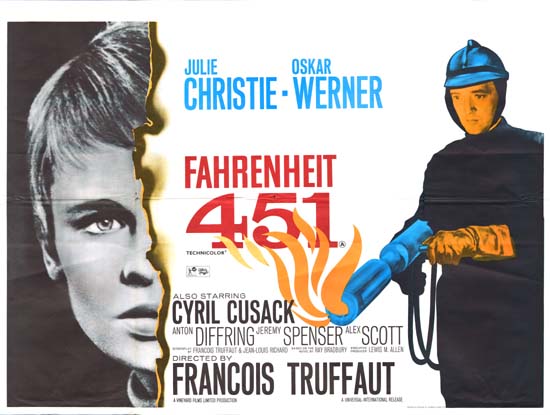
A poster for the 1966 film version of Bradbury's novel
I miss Ray Bradbury. Even having lived for 91 years and authored over three hundred short stories, it seems still too short a time to have graced our society with his presence, still too few works for someone of his talent. I don't remember exactly when I first read Fahrenheit 451, sometime in junior high, followed quickly by the haunting stories in The Martian Chronicles, but I know that like many of the classics I read in 7th and 8th grade I didn't understand it nearly as well as I should have. Fahrenheit 451 strikes me much more now than it did then, perhaps because we are much closer to Bradbury's dystopian future than when I first read it. I recently finished re-reading the book in advance of a book discussion at the library this week, and it is remarkable how prescient Bradbury was, writing in the early fifties during a time of increased paranoia about the advance of communism and censorship of opposing views.
Bradbury was famous for saying that you needn't burn books to destroy a culture, you merely needed to get people to stop reading them, and his novel tells exactly how that could come about. Sometime after the year 2022, a point was reached where people have not only stopped reading books, but brigades of firemen exist to burn them along with the people caught holding these last few physical reminders of the past. In talking with the protagonist Montag about how this came about, the fire chief Beatty says that people began to find them unpleasant. They feared the unfamiliar, and the word intellectual "became the swear word it deserved to be." The contents of books made people unhappy; therefore in the interest of keeping everyone happy the books were to be burned. The populace was distracted from societal problems and war by endless commercials, five-minute romances on the television walls of their homes, ear pieces that fed endless entertainment but nothing of substance to upset them in their state of endless docility.
Ray Bradbury was right in so many ways. I wonder if he thought in his later years about how our society was coming ever-closer to resembling that future society portrayed in his book? There has always been ignorance and anti-intellectualism in American society, but it seems to be on the rise in the past decade. The cranks and the charlatans who have always peddled anti-intellectualism have mostly existed at the fringes of our society, but they are now taking center stage. Where once we valued education and learning, we now have vandals in our society who make it their mission to attack education, denigrating the value of learning beyond a narrow, career-focused path, denigrating the work of teachers and educators at every level from pre-K through college, and seeking to defund and destroy our systems of public education. Educated people, after all, have the capacity to ask questions that are often uncomfortable for those in charge, and who wants to have to address these uncomfortable questions?
Where once we valued the work of science and the progress it could achieve in making our lives better, we have an entire political ideology thoroughly invested in attacking the core validity of science itself, smearing a non-partisan process of investigating the natural world as a partisan, hostile adventure. Science, after all, has the capacity to raise questions and reach conclusions that society might find uncomfortable. We'd much rather watch some scripted bickering on a reality television show and not think about it. Even the obvious good vaccines have done for our species is not safe from the anti-science charlatans, who by their denial of science have allowed us to reach a point where once-vanquished diseases like measles and mumps are making a comeback among children in various parts of the country.
These worrying trends are combined with a society that is less interested in reading than it once was. Almost a quarter of Americans didn't read a single book in the past year. Not one. That percentage has tripled since 1978. Bradbury was right again. No one has to ban books (though challenges to materials in libraries remains distressingly high) if people simply stop reading them.
While there are certainly bright spots in this abysmal picture, we are well on our way to becoming the society that Bradbury warned us about nearly seventy years ago. We are not there yet, but we seem content to keep marching blithely down that road, no matter how many times someone tries to sound the alarm and shake us from our stupor.
There is still time to change course.
Comments
Post a Comment