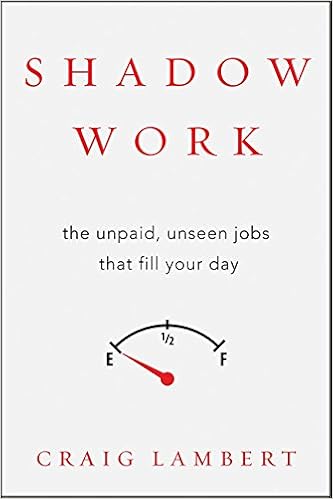
Writing in 1928, the economist John Maynard Keynes made the assertion that the progress of technology, and the automation of work, would lead to a point in time where workers would put in about fifteen hours per week, with three hour work days being a normal part of society. Keynes was hardly the only thinker to predict a future of leisure for humanity, where we were freed from the necessity of excessive toil by the machines we created. Yet this future failed to materialize, and it seems that we have even less leisure time than we used to. Why is this? Sociologist Craig Lambert asserts in his new book Shadow Work: The Unpaid, Unseen Jobs That Fill Your Day, that part of the answer is the rise of "shadow work."
The author chooses not to focus on the increasing amount of time Americans are putting in at work, nor an economic system that requires many poorer workers to spread their time across two or three different jobs, but instead on the hidden trends that erode what free time remains. Lambert defines shadow work as any unpaid job "an industrial economy spins off for its citizens (4)." These are often tasks that corporations or other organizations used to do with paid workers that they now have pushed onto the consumer. Booking your own travel accommodations, bagging your own groceries, even busing your own table at an eatery are "shadow work," in that in the not too distant past these used to be tasks performed by paid workers.
It was this hook that made me interested enough to borrow the book from my public library, but only the first few chapters seemed to really focus on this phenomenon as the author defines it. Using self-service gas stations as a key example in his argument, Lambert charts how in all but two states full-service gas stations have practically disappeared in favor of customers pumping their own gas. For reasons of economy, labor, and convenience, we as consumers have come to take on the shadow work of filling our own tanks, in exchange for perceived benefits of one type or another. Similarly his chronicling of the evolution of grocery stores, from full-service companies that pulled and bagged desired items while the customer waited to places where we retrieve, bag, and pay for our own items in self-checkouts, is a strong example of the kind of hidden tasks he defines as shadow work at the beginning.
Yet in writing about shadow work, Lambert goes far afield from his own definition of what this kind of work is, a definition that itself sometimes seems too broad to be useful. It is clear that having to sift through automated phone menus so that companies can hire fewer human workers is shadow work. It is also clear that the trend of always being connected to work through email or phone (in an example given near the beginning of the book), while a disturbing reality that cuts into leisure time, is not itself "shadow work," so much as the encroachment of work onto our leisure time that technology makes possible. Salaried workers are, after all, still technically being paid when they opt to check email after work hours. Similarly, the self-imposed duties of the helicopter parent cut into free time, but these are not shadow work as he defines it.
What Lambert does well is to point out the ubiquity of shadow work, to document how it has come to quietly demand increasing amounts of our time over the last century. Through myriad examples, we see how shadow work has steadily eroded leisure, yet the author dismisses the notion that this is a problem to be solved. He derides as simplistic the very idea of viewing this trend through the lens of "problem-solving." Making us aware of shadow work is his stated goal, and he achieves that, calling us to see this as an opportunity we can constructively and creatively shape to our own benefit. But while not all forms of shadow work are bad--many are beneficial for consumers--some forms clearly are. Surely these negative forms shouldn't merely be shrugged off?
Lambert views the rising tide of shadow work as unstoppable, and laments the loss of human connection that this entails. He paints two dismal possible portraits of the future that may result from this disconnection; it is here that he goes furthest afield from his intended purpose, and these flights of fancy weaken the book overall. Shadow work is all around us, and we need to understand it more clearly. Lambert deserves thanks for pointing it out, but it may be hoped that other sociologists and economists will follow with further, more rigorous, discussions of the topic.
Comments
Post a Comment