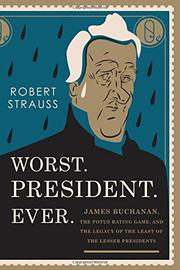
I've long been fascinated by the occupants of the White House, along with the history of slavery in the United States. Given that, a book like Robert Strauss' new biography of James Buchanan, Worst. President. Ever., was going to be a must-read regardless, even if it hadn't been given such a catchy title.
Plenty of ink has been spilled about great men who've held the highest office in the United States. Any reader interested in learning any imaginable minutia about the lives of Lincoln, Washington, and the Roosevelts have hundreds of books to choose from, including multi-volume doorstoppers like Edmund Morris' three volume biography of Teddy Roosevelt, coming in at over two thousand pages. But with forty-four presidents having taken the reins in our two hundred forty year history, inevitably not all come out looking so great. While the current vogue is to label either George W. Bush or Barack Obama as the "Worst President Ever," depending on your political persuasion, there are plenty of truly horrible presidents who have held office. Strauss argues, with facts and a little humor, that James Buchanan, the only president from Pennsylvania and the immediate predecessor of Lincoln, more than merits the title.
Part-biography, part travelogue, part meditation on what makes a truly terrible president, Strauss explores the failed one-term presidency of Buchanan, his ascension to high office the culmination of a long career in law, diplomacy and politics. While Buchanan was highly qualified on paper, his deep desire to please everyone came at the wrong time in our history. His attempts at mediating the growing divide between Northern and Southern states backfired spectacularly. Buchanan meddled in the Dred Scott decision, pushed for the annexation of Cuba as another slave state, and botched the handling of John Brown's attempt to provoke a slave revolt in Harper's Ferry. Each action, meant to ease the tension between slave and free states instead pushed the country inexorably towards war and left Buchanan befuddled. Perhaps the kindest thing that can be said about Buchanan is that he wasn't corrupt--just deeply incompetent. His best action as president wasn't even his intention; his deep hatred for Stephen Douglas led him to undermine the Illinois Senator in the 1860 Presidential Election, helping ensure a Lincoln victory. As South Carolina seceded, he ignored the requests for reinforcements from the commander of Fort Sumter and took the stance that the Constitution gave him no powers to stop the flight of the South. After his Administration, Buchanan rubbed salt in the country's wounds by insisting in his memoirs that everything would have been fine, if it hadn't been for those meddlesome abolitionists.
While some parts of the book repeat a bit, Strauss' diversions into the Administrations of some other notably terrible presidents like Warren Harding and Franklin Pierce provide useful contrast, bolstering his case for Buchanan at the bottom of the list. His talks with historians about how the rankings change with time--the reputation of some presidents improving while others lose esteem--were a fascinating window into our changing values. Even someone who might not be interested at all in Buchanan will find the rationale for ranking the presidents fascinating. The discussion of just what we can learn from failed presidencies is illuminating, regardless of what side of the political aisle you're on. For all these reasons and more, put down that Washington biography and give Worst. President. Ever. a read. Unlike the voters of 1856, you won't regret giving Buchanan a chance.
Comments
Post a Comment