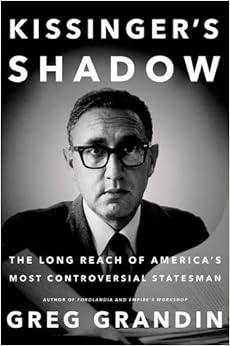
I was intrigued when I came across a review of a forthcoming book that sought to reconcile the seemingly contradictory legacies of former Secretary of State Henry Kissinger. A few months later, I borrowed a copy and was enthralled by what the author had to say. Greg Grandin, author of well-received books like Fordlandia and Empire of Necessity, tackles the thorny issue of one of the United States' most notorious diplomats in Kissinger's Shadow: The Long Reach of America's Most Controversial Statesman.
Drawing on newly declassified documents, Grandin's portrayal of Kissinger is far from complimentary. While giving him credit for his role in helping to normalize relations with China, and in brokering an arms-reduction treaty with the Soviet Union, the majority of the work zeroes in on acts that were an outgrowth of Kissinger's own philosophy of history, as outlined in his undergraduate thesis. Decline, Kissinger wrote, is not inevitable in a great power, so long as it acted decisively to maintain that power. This is the theoretical underpinning that drove acts as varied as the illegal bombing of Cambodia during the Vietnam War to Kissinger's tacit support of right-wing death squads in Latin America during the 1970's. The consequences of the action were not important, and it was irrelevant whether the act itself had been right or wrong. What was important was that a great power act quickly, often merely for the sake of displaying its power. Kissinger would never second-guess himself, and has steadfastly stood by the rightness of his decisions. When Vietnam-era Defense Secretary Robert McNamara publicly apologized for his role in the conflict, Kissinger mocked him for his contrition. From Kissinger, there would be no apology, not then and not ever.
In spite of the disastrous consequences of his decisions, in the post-Vietnam War era of his service in the Nixon and Ford Administrations, Kissinger doubled down. He helped facilitate the flow of weapons to the Shah of Iran, who was himself helping Islamic terrorists destabilize Afghanistan. He supported the murderous actions of governments in the Philippines and Indonesia, and he quietly allied with the apartheid regimes of Rhodesia and South Africa in proxy wars across the continent. In the name of "decisive action," he even suggested military seizure of Saudi Arabian oil fields, just to show that the U.S. could.
Beyond his own foreign policy decisions, Grandin argues, Kissinger's greatest legacy was his rebuilding of the national security state, his justification of endless war for the sake of appearing strong, and his idea that governments could bend reality to their will, if only they worked hard enough. In spite of his foreign policy blunders, Kissinger has shown himself to be amazingly adaptable. Initially disparaging of Ronald Reagan, and a hated figure on the Right in 1980, Kissinger reinvented himself for the ascendant conservatives on the Right. While his reputation has waxed and waned in later decades, Kissinger positioned himself as an elder statesman, his opinions sought on both sides of the aisle. There were few conflicts he didn't like, so long as America appeared strong, and he served as a cheerleader for the invasion of Panama, and both Iraq Wars. Many actions that were controversial in 1970 became commonplace, Kissinger having paved the way. Grandin's accounting of Kissinger is by no means balanced, but it never pretends to be. The author's deft handling of the sources, and engrossing writing style, combine to result in a fascinating portrayal of the statesman.
Comments
Post a Comment